Pantheon Release – Three Months as a Published Novelist

All joking from the one month update aside, I can tell you that I am still not writing from my private island while surrounded by my enormous piles of money. Bummer.
In my one month update, I talked about misconceptions I had and the realities I faced: not everyone is an overnight success, it does not mean instant popularity across social media, the hustle is both real and necessary, and I am not instantly or fabulously wealthy. But after three months, I’m starting to see the intangible wins and working on setting my goals for 2021.
First note, I don’t set New Years Resolutions; I set New Year’s goals. A resolution can be broken and, once broken, it’s done. A goal is solid. A good goal is specific, measurable, and achievable but still pushes you. So rather than bore you with some sad wheeze about why I didn’t achieve my goals in 2020 due to [fill in the blank], let me instead give you an update on those misconceptions and how I’m setting goals for 2021.
Misconception 1: My book will be a runaway hit! I’ll sell millions!
Reality: The average debut novel sells 250 copies—some as few as 5.
3 months later reality: The number of debut novels sold is almost irrelevant
2021 Goal: Keep cranking out the books!
In the last post, I noted that I wanted to beat the average and sell enough books to earn back my advance. After some forthright and honest conversation with my publisher, I’ve learned two additional things. First, making back my advance in the first year is unlikely as a new author. Second, getting my name and story out is of primary importance. I also don’t feel like my second or third books are on shaky ground either, even if I don’t make back my advance. I’ve been able to show that I am willing to hustle my rear off promoting this book. (More on the hustle later.)
Misconception 2: I will suddenly become very popular across social media
Reality: I’m a little bit more popular, but I hustled my rear end to gain followers
3 months later reality: Still working to build my fan base, but finding more avenues than social media
Goals: Build a loyal and active fanbase (Same for 2021)
In the two months since the last post, I’ve continued growing my Twitter, Facebook, and blog following. I’ve also started a mailing list. Partially because I want as many ways as possible to reach folks and because social media streams are so saturated that if a follower isn’t online as I post, they lose the potential to see a post within three hours; an email is ready for them at their convenience. I also came up with other creative ways to reach folks like Val’s Twitter takeover and a follow-up article on Medium about the lessons I learned from it.
The second aspect of this is people exactly like my spouse and me. That person who sees a book is part of a series and won’t bother picking it up until several books in the series are available to binge. Heck, I didn’t even pick up Jim Butcher’s Dresden Files until he’d produced three or four books. Knowing this helps me focus my goals on getting those first few books out as quickly as I can without sacrificing the writing or editing quality.
Misconception 3: I can take a breather now that the hard work is done
Reality: I have worked an average of 1-2 hours a day after work and an additional 4-6 hours on the weekend since the start of September
3 months later reality: Work smarter, not harder! I work fewer hours and more intelligently to build recognition and interest
Goals: Position myself to take advantage of opportunities as they come (Same for 2021)
I’m still working to position myself to take advantage of opportunities as they come up. An introduction back in the spring enabled me to get an excerpt of Pantheon published in Military Times. My connections and friends who advocate on my behalf have gotten my book in front of people who have enjoyed it and talked it up on my behalf. Or, maybe, lost a running bet and wrote a blog post about what Pantheon meant to them. The most delightful surprise was being added to the Modern War Institute’s 2021 Reading List under the category of “Military Fiction and Sci-Fi.”
Misconception 4: I will be fabulously wealthy from sales
Reality: I will be very happy to earn back my advance!
3 months later reality: See Misconception 1
Goals: As with the sale numbers, I want to sell enough to keep selling. If my book tanks, then I may not get another shot.
2021 Goal: keep producing quality military thriller and urban fantasy novels as well as short stories and blog posts about fitness on my blog
As many of you know, I have submitted the manuscript for Pantheon’s sequel, and my goal for 2021 is to get it out to you all. I hope to announce the title soon! What some of you don’t know is that I have finished the overarching five book plot for the whole series. And what only a few people know is that I have finished the primary plot arc of book three with several chapters written. I intend to finish all primary writing and edit this year and will strive to get the manuscript to my publisher before the end of 2021.
There was a new misconception I recognized that ties in with Misconception 2; social media isn’t the only thing that sells a book. In fact, reviews as probably the most important part. It’s how potential readers decide to buy my book if all they see is its page on Amazon. GoodReads and Amazon reviews were my primary source of reviews until the Modern War Institute and Military Times reviews came out. I have been very pleased with my rankings, but I’ve also discovered that the more positive reviews, the more the algorithms pick up my books. One quick plug, if you’ve read the book, please review it on GoodReads and Amazon so more people can be introduced to Pantheon.

The last two months have been as enlightening as the first month after publishing. Every month I learn something new: a new marketing technique, an area in which I can improve as an author, who my audience is and what they want, and what reaches people. This has all helped me shape my goals for 2021: grow my audience, keep producing captivating and exciting fiction, and keep hustling to achieve my dreams.
Thank you to all the people who have supported me. Thank you to every person who took a chance on a new author, to those who posted photos of Pantheon out in the wild, and who told a friend or wrote a review. You all have helped me build a dream for which I will always be grateful. For those who have read and come asking for more, I promise the next book is on its way!
2020 was a right bastard, but not everything was a dumpster fire and I hope to carry those good parts forward into 2021!
Enjoy what you just read? Please share on social media or email utilizing the buttons below, fans like you sharing what they love are what keeps this train rolling!
Want to read more works by Author KR Paul? You can find my first novel here and its sequel here.
Want more than that? Follow me on Twitter, Instagram, Facebook, and TikTok. Stay up to date on the latest KR Paul news by joining our mailing list.
Just looking for wild stories of cave diving, ultramarathons, blacksmithing, or powerlifting. Yeah, I’ve got those too!
Race Report: BUTS Heavy Half

By this point, you’re read all about my current training cycle and I chase down that ultramarathon goal. This past weekend was an important final step: my first tune up race. It’s the chance to get my feet in the dirt and grind it out with the best of them. This important first race gives me an idea how I’m performing on race days, gives me a chance to dial in my nutrition, and time to tweak my training plan before the big race.
Today you’re getting my full race report for the Birmingham Ultra and Trail Society (BUTS) Bearly Ultra, the 13.5 mile Heavy Half course.
Check in:
Easy peasy. It was a single tent at the race start and I had my swag and bib number in under two minutes. Remember, ultras are low population events and this one was limited to 50 participants per event (ultra or half).

Starting line:
It was a small crowd milling around at the entrance to the park. Not much fanfare, as expected. We got a few notes from the course director on what the trail markers would look like but that was about it.

The course:
Weather: It was about 40F at the start which is really the borderline for a lot of my gear. If you followed the thread on Twitter then you know I elected to drop my windbreak with 10 minutes until race start. In the sun I was warm with a tank top and long sleeved shirt. However, later in the race, after some hills climbs that got me sweating, I was chilled to the bone on the ridge crossing because of the wind. My rule of thumb is to mentally add 20 degrees to the thermometer for what it will feel like running. (e.g. – 40F would feel like 60F once running, 70F feels like 90F) That said, it doesn’t factor in things like wind and shade. I was very lucky it stayed sunny the whole time or I think I would have had real hypothermia issues.
Trail conditions: Because it was sunny and dry the days before the race the trail condition was perfect. Little to no mud, not creek crossings, and Red Mountain Park is meticulously groomed and maintained.
Terrain: *deep inhale* Screw this course! Ok, that said, any problems with the terrain are 100% my fault. The race director had created a good, challenging course and its on me for not doing enough hill work in my training spin up. About 1600’ of the course’s total 1800’ of climb come in the first 6 miles. The first mile ends in a climb nearly to the highest elevation and it goes on from there. Miles two through seven are very technical climbs and descents. Its slow going up and if you’re clumsy like me, you’re taking your time to pick your way back down the hills too. I averaged 16 and 17 minute miles in some areas.

Aid stations:
Again, if you read the Twitter thread, you saw my frustration here. In normal year there is a water only station around mile 3 then a full aid station you cross at mile 6 and (supposedly) mile 9. This year they skipped the water only stop and asked everyone to carry sufficient water. The milage for the second stop at the only aid station was way off, listed at mile 9 but I crossed it at mile 11. I was so frustrated that I ended up blowing past it the second time without stopping for more than a quick “thank you” to the volunteers. It was a slim selection too as everything had to be pre-packaged for safety. I relied on my own supplies.

Did I hit the Pain Cave?
Yes. Absolutely. Miles two through six where miserable with those hills but I came out of it around the time I hit the aid station at mile 9. There were a few points where I wasn’t super “up” but nothing like the hilly sections.

The unknowns:
I didn’t think about how much I dislike eating when I’m cold. I should have been putting down a snack about every 2-2.5 miles. Over the course of 13.12 miles, I only got 2.5 snacks in when I should have consumed at least twice that. I burned 1700+ calories and only put in 500 and I felt the deficit by the end. I am glad I had what I carried since nothing at the air station looked good (boiled potatoes, bananas, and water) but I should have eaten more and carried something with a little protein in it.
The other impact of the cold was that I did not want to drink my water. It was cold, I was cold, and I had a hard time making myself drop ambient temperature was directly into my core when I was already cold. I saw the impact of that later in the race when my heartrate was jacked up through the roof (165-180bpm) even when I was running an easy pace on a gentle downhill. Be smart kids, drink your water!

Crew:
No crew for this race, it was too short and limited access due to COVID.
The finish line:
Minimal. I flashed my numbers and they recorded me complete, I snagged my cool mug, and headed to my car for the long drive home.

Final time:
3:09:12 which means I came up short on my goal of being sub-3:00.
Overall thoughts:
I was not ready for the hills but this was a good kick in the rump and will keep my humble and realistic about Mississippi 50 in March. While I feel like the hills kicked my rear end, a day later, I don’t feel terrible. I don’t feel that I need to tweak either my training plan or nutrition before MS50. MS50 is a much flatter course, with minimal hills that match what I have down here in the Panhandle so adding hills would be unnecessary.
The Gear List:
I’m going to start adding gear lists to all my runs so folks can see what I’m carrying and how it changes between courses and weather. Some affiliate links, most aren’t.
Clothes:
Mask: Under Armour Adult Sports Mask – required to run. Must wear item for check in, race start, and going through aid stations. I wore this around my hotel but wore my 2020 MS50 neck gaiter for the run. Should have worn the UA mask.
Top: Nike Women’s Dri-Fit Element Long Sleeve Running Top – This one is a good top (45-55F) or middle layer (<45F). Plus, thumb holes and it covers half my hand.
Tank top: Nike tank top. Designed to indoor workouts like weight lifting but does well running too. Great as an only layer (>60F) but does well as a base layer too (<60F).
Bra: SheFit ULTIMATE SPORTS BRA – a qualified “good.” I like that you buy based on cup size and both the chest band and shoulder straps are adjustable; it’s probably the most comfortable sports bra I have. That said, the metal loop that holds the chest band tab tore my back up after 5 miles. I had some gnarly chaffing there and will need to look at other options in the future.
Tights: Curve ‘n’ Combat Boots Empowered Black (V1) – As with my bra, its not desired as running gear but it fits me well and does the job. These are designed as weightlifting tights and the dimensions are for a woman with thick legs. Like, babe you are squatting 225lbs as a warm up and the squat boots/thighs are strong and the waist is small! They fit me perfectly but if you have a more traditional runner’s body then they may be too baggy or slip while you run.
Socks: Balega Blister Resist Quarter Socks – These are thick and comfy but the “blister resist” is only as good as how well you lace your shoes. I did not lace my right shoe tight enough and have a small blister to show for my slipping around inside the shoe.
Shoes: Altra Olympus Trail Shoe – These have the thickest soles of my trail shoes and for the technical climbs, I should have sacrifices some comfort for trail feel and gone with my slightly thinner Lone Peaks.
Gaiter: Altra Trailer Gaiter – Designed specifically for Altra trail shoes and fits well (will not work on other shoes!). Kept out the sand pit I slogged through around mile 3 of each loop.
Gloves: Cheap ($1) knit cotton gloves bought from either Michaels or Hobby Lobby a few years back. I highly recommend finding a very cheap cotton glove to carry. Expensive bougie gloves are great but get lost so often… buy the cheap ones and they’ll never disappear on you.
Hat: Brooks and probably some type of dry fit? It was a gift from my wonderful spouse so I have no idea where he purchased it. Wears well and kept my head warm.
Nutrition:
Vest: Ultimate Direction Ultra Vesta 4.0 – This is my “new to me” but “older model” vest I got on sale for half price. There’s a new version but I’m glad I gambled on buying this one as it’s been a real champ. Lots of easily accessible pockets, good bottle holders, and the bladder holding set up keeps it from rattling around or slipping its loops like my other vest. Not as easy to access the bladder for refills once it’s on but I didn’t need a refill this race so it hasn’t impacted me yet.
Liquid Salt/Carbs: Gatorade Endurance Formula Powder – purchased with coupons on the Gatorade website which is good because I don’t love it. It’s not as strong a flavor as regular Gatorade and it does well for replacing salt/carbs quickly but… I dunno, maybe I’m too picky, I don’t love it. But, I’m kind of a cheapskate and won’t buy anything new until I finish this container.
Snacks: Both the Honey Stinger Organic Energy Chews (caffeinated version) and the Honey Stinger Organic Waffle. For the cold, this wasn’t a great pairing. The waffle was stiff and hard to chew from cold and since the chews are caffeinated, they aren’t a good “only” option. I supplemented with snacks from the aid station during this race. But for a race in more normal temps, they work really well for me.
Other:
GPS: Garmin Forerunner 945 – Held up like a champ, no issues and seemed to give a good, if horrifying, read out for my climb data.
Happy trails!
Enjoy what you just read? Please share on social media or email utilizing the buttons below, fans like you sharing what they love are what keeps this train rolling!
Want to read more works by Author KR Paul? You can find my first novel here and it’s sequel here.
Want more than that? Follow me on Twitter, Instagram, Facebook, and TikTok. Stay up to date on the latest KR Paul news by joining our mailing list.
Just looking for wild stories of cave diving, ultramarathons, blacksmithing, or powerlifting. Yeah, I’ve got those too!
Confessions from the Trail: Taper Tantrums

My first taper week of the season starts today and like all taper weeks, I’m going to apologize to my spouse upfront. Because, dear friends, taper week is a bastard and I will be a right bastard too.
Taper week is well known to any endurance athlete. Whether you’re a runner, cyclist, triathlete, or crazy ultramarathoner, it’s wise to use the week before a race to let your body catch up, rest up, and fuel up so you’re at your peak strength and endurance on race day.

Most of us will gradually cut our workouts down, usually making the day or two before the rest days or very, very limited workouts. We also add more water and carbs into our diets to ensure our depleted muscles are full of glycogen once more (aka – carb loading). And lastly, if you’re like me, you cut out alcohol and excessive sugar while increasing the number of veggies I eat to ensure my diet is dialed in.
All of this is designed to get my body at its peak, so why is taper week so hard?
First of all, I love to exercise. I love working out. I love pushing my body. So, going from consistent workouts to almost none leaves me with energy and little to no outlet. It’s also like an itch in my brain. A low grade feeling of unease because I should be out running and I’m not. I should feel the drag of tiredness in my limbs, but instead, I have energy I NEED TO GET OUT!
Second, the extra carbs. I eat a moderate amount of carbs, maybe less than an average endurance runner because of my bodybuilding background, so when I add more in, I feel bloated and heavy. My weight will spike too as added glycogen means more water is held in my system, which will, of course, push my weight higher. I don’t really feel the weight as I move, but I get a little belly bloat, which is uncomfortable and mentally, I don’t like seeing the scale go up.
And finally, my vices. Oh, my sweet vices. I like a drink and I have a sweet tooth. I know both are moderately bad for me but taken in small doses, I don’t feel like I’m hacking years off my life. But cut them both out entirely and I get cranky.
So, as a recap, I have energy but no outlet, I’m bloated and heavy, and I’m cranky from a lack of sugar and alcohol. It’s sort of like being pregnant.

There is a final factor: race stress. It hits us all differently. Some people roll up to the starting line without a care in the world. Me? I stress all week long and for no damn good reason. I am unlikely to climb on a podium. The possibility is so remote that I don’t know why I stress. Maybe I risk injury, but with a wise race pace and not getting caught in my own head or mentally writing my next novel, I should be able to avoid most accidents.
I don’t know why I stress like this. But it happens every time. I spend the night before restless and afraid I’ll miss my alarm. I roll up to the starting line, tired and stressed, eyeing every other racer to see how badly I’ll get crushed. Then the gun goes off … and the stress evaporates. The hay is in the barn, as my academic advisor would tell me. There is nothing I can do to alter my performance now. The training is done. The stress can relax. Now I just have to finish.
But today is the start of taper week. A week of healthy eating, reduced workouts, and all the associated crankiness, stress, and irritability. Be kind to your tapering friends. You might get your head bitten off otherwise.
Sorry in advance!
Happy trails!
Enjoy what you just read? Please share on social media or email utilizing the buttons below, fans like you sharing what they love are what keeps this train rolling!
Want to read more works by Author KR Paul? You can find my first novel here and it’s sequel here.
Want more than that? Follow me on Twitter, Instagram, Facebook, and TikTok. Stay up to date on the latest KR Paul news by joining our mailing list.
Just looking for wild stories of cave diving, ultramarathons, blacksmithing, or powerlifting. Yeah, I’ve got those too!
Confessions from the Trail: Race Day

I’ve talked about chasing the ultra goal, why I run, training, nutrition, pre-race, and the lingo of ultramarathons, but what about race day itself?
In this house, we know that ultramarathoners are a rare and wild breed. We run longer, rougher terrain then our road racing counterparts while fueling on things that would make our Mother’s roll their eyes and our doctor’s gasp in horror. We are unafraid of peeing in the woods. (Ok, maybe a little afraid.) And running through a day and night is just your typical 100 miler.
But aside from the bizarrely different mental attitudes, there are a few other things that make an ultramarathon different from a typical road race.
Picking a race: If you are wild and crazy enough to try an ultramarathon one of your first steps is picking that race. You know from the lingo post that UltraSignUp is the place to go and which distance/time is your style.
Once you get over your nerves, race day is actually only a little different than a road race. The biggest difference is that the highest are higher, the lows are lower, and the distances are longer. This that, these are the few notable changes.
The unknowns: Weather, your fellow runners, and a new course always qualify as “unknowns” but in ultramarathon, they’re amplified. A 5k in bad weather is, at worse, a miserable 30 minutes. In an ultra, you could be slogging it out in life threatening cold and rain for hours. With your fellow runners, sometimes whether you place or come in last largely depends on who shows up that day. It’s a lot like body building in a way. For the course, even a seasoned runner can be thrown off on a familiar course if weather has altered the trail significantly.
Aid stations: As I note in the nutrition post, ultramarathons aid stations are the wild west. You never know what you will encounter. Elvis impersonator giving out hamburgers? Seen it. Hell, that aid station even had plastic pink flamingos to complete the Trailer Park Chic look. Some are a buffet of the greatest junk food known to runners. Some are not much more than water and Gatorade. Always pack your own snacks! Some will also have mandatory health checks. Don’t be an ass, let them take your vitals and keep going; they’re here to keep your race drunk brain from killing your body.

Digging deep: If you’re read The Pain Cave you know what I’m talking about. I start every race knowing I’m willing walking into the pain cave and that I will have to dig deep into my own will power to come out again.
Crews: Unless you’re a super-elite racer, you don’t get a crew during road races. Many ultramarathons will not only allow crews, but encourage runners to bring a crew. They will help keep your kit, double check your health and sanity at each aid station, and tell you beautiful lies about how well you’re doing. “You look great!” and “You look strong!” are the best lies any crew will ever tell you.
The finish line: Sweet bliss to see but it has far fewer frills than your average road race. There are fewer racers, for one, so you aren’t queuing up for that bottle of water and a single banana, which is nice. On the flip side, there’s no after party with blaring music and a DJ announcing each finisher.
Happy trails!
Enjoy what you just read? Please share on social media or email utilizing the buttons below, fans like you sharing what they love are what keeps this train rolling!
Want to read more works by Author KR Paul? You can find my first novel here and it’s sequel here.
Want more than that? Follow me on Twitter, Instagram, Facebook, and TikTok. Stay up to date on the latest KR Paul news by joining our mailing list.
Just looking for wild stories of cave diving, ultramarathons, blacksmithing, or powerlifting. Yeah, I’ve got those too!
Confessions from the Trail: Ultra Lingo

Ultra has its own language. So, in a completely arbitrary order, the words you need to know about ultramarathon speak.
Timed race: Ranging from six hour to three days, a timed race is exactly what it sounds like. The race director sets a single looped course and participants run until time expires or they do. Courses tend to be about 5k or 10k long so participants can return to their cars, crews, or drop bags with relative ease.
50k: 31.1 miles of fun and excitement. Also typically acknowledged as the first ultramarathon distance. Technically, anything longer than a marathon is an ultramarathon, but most runners, like myself, aim for the 50k as a first ultramarathon.
50 miler: 50 miles of grinding it out. Seen as a “real” ultramarathon by those who’ve run their first 50k.
100 miler: You are insane.
200 miler: You are a running god. We tremble in your toe nail-less presence.
Drop bag: A bag full of gear left at an aide station or race start/finish for looped courses. Usually has socks, shoes, extra snacks, and first aid supplies.
Crew: Our crazy, loving friends and significant others who are willing to follow from aid station to aid station with your supplies and a word of motivation.
Pacer: Our crazy, loving friends/significant others who is willing to run with us for a section of trail. Their duties include reminding you to eat or drink, keeping your spirits up, and lying about how well you’re doing.
DNF: Did not finish. Hey. It happens. But at least you started.
DNS: Did not start. It also happens. But at least you tried.
DQ: disqualified. You done fuck up, Chuck.
Power hiking: Walking. It’s walking. Recommended on hills. And sometimes flats. Any time you need it really. Its about surviving.
Elites: The running gods. These are the fast folks who will place in the Top 3. Probably before you hit the halfway mark.
Age Grouper: The demi-gods of running. You are good enough train and finish the race but will be place among peers of your own age and gender.
Strava: That cheerful orange app that let’s you brag about your finish. Or become the Local Legend as you train. Or what drives people to be Stravassholes and stand around at the start/end of a course waiting for GPS/data to synch while others are running through.
Chicked: At longer distances, men’s and women’s time start evening out. One of the fastest ultra racers in the world is the fabulous and humble Courtney Dauwalter. If you are a fella and have been beaten over the same course by a woman, you have been chicked.
Note: My husband now refuses to race with me. AT 5k, 10k, and half marathon he kicks my ass. At marathon distance we’re damn close. In an Ironman 70.3, I beat him by an hour and a half (I finished in 6:39, he was a hair under 8 hours).
Belt buckle: Ultimate bragging rights. Throwing back to it’s roots as a horse race, many races offer a belt buckle for finishers of certain distances. For example, Mississippi 50 gives buckles to the 50 mile finishers but 50k and 20k finishers get a small medal and at BUTS, the half racers get a mug.

Lollipop: An out and back trail with a loop in the middle. This one seems rare, but I use it to describe several of my trails via Twitter.
Chaffing: Friction and not the good kind. When skin is rubbed by fabric, gear, or other skin of long enough it will chafe. It sucks. Use lube, just like the other kind of friction.
UltraSignUp: The repository of all ultras. You want to race and ultra? You’re going to find your race here.

Happy trails!
Enjoy what you just read? Please share on social media or email utilizing the buttons below, fans like you sharing what they love are what keeps this train rolling!
Want to read more works by Author KR Paul? You can find my first novel here and it’s sequel here.
Want more than that? Follow me on Twitter, Instagram, Facebook, and TikTok. Stay up to date on the latest KR Paul news by joining our mailing list.
Just looking for wild stories of cave diving, ultramarathons, blacksmithing, or powerlifting. Yeah, I’ve got those too!
Confessions from the Trail: ‘Tis the Season (For Illness)

Season’s greetings from my couch. Yup, like many this time of year, I’m sick. Unfortunately for me, I’m also supposed to race in two weeks and seriously, body? THIS IS NOT THE TIME! But it was also somewhat inevitable…
Since it’s apropos and I definitely have time since I’m not running today, this post is all about getting sick during a training cycle. I’ll be giving you some insight into why it seems to happen so often so close to race day, help you decide if you should keep training or not, and help settle your fears (and mine) about whether you can race.

Why am I sick? I lead a healthy life!
Let’s knock the first question out of the way: at this point, my doctors don’t think I have COVID-19, my breathing is fine, and I likely have a bacterial infection (yay, strep throat…). But like many of you who experience this so close to race day, I’m thinking, “why, oh why does it happen now??”
There’s a fairly simple answer: I’m depleted. I’ve been running hard and long for months now. Last week Sapper and I did our “Runningest Writer Showdown” for the Fisher House Foundation. I ran the hell out of myself through bad weather, hot on Thanksgiving and then cold and rainy on Sunday. No, the old wives’ tales that cold, wet weather makes you sick is just that, an old wives’ tale. But, when you’re already run down from hard training, as you would be toward the end of a training cycle, it’s harder to fight off those opportunistic bugs. I am utterly unsurprised even though I’m annoyed.
To train or not to train?
This is where you have to use sound judgment. The typical run of thumb is if your symptoms are from the neck up (runny nose, sore throat), you can keep training and if it’s below the neck/full body (cough, full-body aches, fever, fatigue, nausea) don’t train.
**COVID-19 caveat!** If you suspect COVID-19 at all, I had better not see you on a trail. Stay home, call your doctor, wear your damn mask. Most COVID-19 symptoms fall under the “below the neck” category, so you probably won’t choose to train through it, but don’t be an ass.
I had a sore throat with nausea and fatigue, so I’ve chosen not to run this week. It sucks, I hate being inactive, but the fatigue pretty much flattened me. I spent most of the last three days lying in bed listening to Force No One on Audible, working on a commercial writing piece associated with my day job, doing homework, playing videogames (hello World of Warcraft expansion!), and feeling sorry for myself.
Part of my fatigue comes from not eating. Low-grade nausea meant everything I could choke down felt like it might come back up, so I didn’t eat much the last few days. Even laying around all day, the body burns calories and, as you saw in “Race Weight,” when when calories in are less than calories out, you lose weight, even if you aren’t exercising. I wish I could say this was the healthy weight loss I wanted, but it’s not. That’s right, friends, starvation is a bad weight loss tactic! The best I can do now is gently add more food into my daily intake, get some strength back, and keep rolling.

What happens next? Oh no, can I still race??
Short answer, yes, you probably can with some important notes. It will depend on how long it takes your symptoms to resolve and how close to your race you are. I have roughly two weeks until the BUTS Bearly Ultra (13.5) and I’m at the tail end of being sick. I have a week to get my feet back under me, return to a healthy and full diet, and get one last long-ish run in before my taper. If I were a week closer, I would have accepted this is my taper week, carried an easy to moderate training load, and only taken a couple of days to taper. (I will cover tapering next week for those unfamiliar with the term.)
When deciding if you should race, here are the criteria I use:
– Am I still feeling symptoms?
Can you train with some symptoms? Yes. Should you race with symptoms? Bruh. No. A normal training load is probably ok to continue training, but the extra stress of racing will overload you. You will extend how long you are ill and risk a Did Not Finish (DNF). Ask me how I know… That’s right, I took a decongestant the days before and the day of Mississippi 50k 2017 and tried to power through. Guess who not only didn’t finish the 50k course (made it 20k and stopped) but ended up on the side of I-20 calling their spouse and asking if they should go to the ER or wait? Yeah, this chick. Don’t be dumb like me.
– Have I returned to a full diet for at least two days?
Training depletes your glycogen stores. It’s why people “carb load” in the days before the race; they’re trying to get fuel back into the muscles. If you haven’t been eating well and don’t get the critical chance to refuel your body, you can’t make it up by eating while you run.
– What is my resting heart rate?
I can tell if I’m overtraining, dehydrated, or ill based on an elevated heart rate. If you have a fitness device that monitors heart rate, you can track it over time and gauge when your heart rate is higher or lower than usual. If I see mine rise by more than 20% (average resting HR: 42, 20% = ~8) to 50bpm or more, I assume I’m sick, dehydrated, or overtrained. In any of these cases, it would be unwise to run.
– Do I feel mentally prepared?
Let’s face it, being sick is mentally taxing as well as physically taxing. I get loopy when my fever spikes. I get stressed by being sick. I get even more stressed when I’m hoping to get better close to a race. You need focus before a race and if your head isn’t in it, today may not be the day to race. I know that BUTS 13.5 has a ridge crossing like you read about: thirty feet of slippery, muddy trail with sheer sloping sides on both sides of the trail. There are firefighters on both sides, but they will only help you *after* you fall. That is not the trail conditions you want to find yourself up against when your head is floating off your shoulders from cold medicines, fever, or worry.
What’s the bottom line?
The course will always be there. There will be other races. Yes, it’s heartbreaking to train so hard for something only to have to bow out at the last minute. But your health is worth more than a finisher’s medal. Be safe, be smart, be healthy!
Happy trails!
Enjoy what you just read? Please share on social media or email utilizing the buttons below, fans like you sharing what they love are what keeps this train rolling!
Want to read more works by Author KR Paul? You can find my first novel here and it’s sequel here.
Want more than that? Follow me on Twitter, Instagram, Facebook, and TikTok. Stay up to date on the latest KR Paul news by joining our mailing list.
Just looking for wild stories of cave diving, ultramarathons, blacksmithing, or powerlifting. Yeah, I’ve got those too!
The Hunt for Beta Readers

As many of you saw from my posts across social media, I am on the hunt for one or two more beta readers for my novels. I’ve gotten a lot of positive responses so far, but a host so questions too. This, of course, means I want to blog about it! Today’s post will cover what a beta reader is, things authors look for in a beta reader, and what I want from my betas.
What is a beta reader?
The basic answer is that a beta reader is someone who will read drafts of a piece before it’s released to a broader audience. This person or people are generally unpaid and it’s their job to help the author find grammatical mistakes, plot holes, or suggest improvements. A beta helps the author add a layer of polish before showing a work off. They are usually the step between finishing a first draft and a manuscript being sent to the editor or publisher.
What do authors look for in their betas?
A beta holds a special position of trust to authors, which drives the characteristics an author looks for in their beta readers. First, of course, a beta reader should have a strong command of the English language (or the work’s primary language). They should be able to catch spelling and grammatical errors as well as things that spellcheck can’t catch, like their/there/they’re. Second, the beta should know something about the author’s style and mindset. This helps them discern what an author might have in the head but have been unable to quite get onto paper. Finally, a beta has to be trustworthy. They are being entrusted with works before release. Authors pour their hearts and souls into writing and many are nervous about showing that work to another person. Additionally, a beta is trusted to read the work and not share details without permission from the author. In a world of modern social media, keeping spoilers from fans becomes a huge part of that trust.
What do I personally look for in a beta?
I like my betas to be a blend of grammar police, advisor, and sounding board. So far, all my betas have been close friends I can count on to catch my dopey mistakes and offer insight into the plot; I lean on each in different ways. My spouse is my first beta and a wonderful sounding board. But he also knows how I think too well, which means he knows what I mean and misses where I haven’t fully fleshed out a detail. My second is Beta Charlie, who I trust to find plot holes and give what I can only call “man advice.” He gives me the male reader perspective and points out where a male character’s reaction isn’t realistic/appropriate. My last beta, who has since gone inactive, was great at finding plot holes, throwing out great ideas, and finding connections in the plot that I didn’t even realize I created. That said, he tended towards Canadian English and grammar, which gave me a lot of comma drama when we were prepping Pantheon for publication!

With my new betas, I need all the things I listed under “What do authors look for in their betas?”: a strong command of English syntax and grammar, trustworthy, and an idea of where I’m going with my work. Before now, I knew all my betas personally, so I could rely on them knowing me well enough to know the shape of my thoughts, even when I didn’t articulate it clearly in my work. Now, I need readers familiar with my current body of work and style: Pantheon, Born Not Bitten, and Confessions From The Trail. I need someone who can kindly point out mistakes and plot holes; offer their thoughts and opinions on the plot without being offended if I don’t ultimately use them; and finally, offer perspectives outside my own. I highly value diversity of thought when it comes to my writing. I need to know when something doesn’t resonate with someone and why. Or when I hit an emotional nerve. Which characters do you love/hate and why? Which characters are just background static?
Being a beta is work, for sure, but you get that early access to works, a chance to guide the plot, and of course, an advanced reader copy once it’s been published! So, if that sounds like it interests you, join the mailing list here. I intend to send details about becoming a beta within the next week.
Enjoy what you just read? Please share on social media or email utilizing the buttons below, fans like you sharing what they love are what keeps this train rolling!
Want to read more works by Author KR Paul? You can find my first novel here and its sequel here.
Want more than that? Follow me on Twitter, Instagram, Facebook, and TikTok. Stay up to date on the latest KR Paul news by joining our mailing list.
Just looking for wild stories of cave diving, ultramarathons, blacksmithing, or powerlifting. Yeah, I’ve got those too!
Confessions from the Trail: Race Weight

Hello fellow distance runners, fitness lovers, and distance runner stans! Today we’re tackling another topic that requires a disclaimer upfront, just like Confessions From The Trail: Nutrition. Ready for it?
I am not, nor have I ever been a certified nutritionist, dietitian, or even remotely trained/certified in telling people what to eat.
Got all that? Cool. Don’t sue me. Any time we talk about nutrition, keep in mind that everyone is a walking chemistry set and what works for me may not work for you. Or, your mileage may vary. Literally YMMV.
Since I’ve already covered nutrition, today, I’ll focus more specifically on weight. Before you get out the torches and pitchforks, please understand that this post will focus on getting the best weight for *your* race. As always, YMMV. Speaking from experience, there is a huge difference between maintaining a certain weight for health, for a bodybuilding competition, and for endurance racing.
When you’re maintaining weight for health, the upper and lower boundaries are fairly wide. As long as you are neither severely underweight nor overweight, your day to day weight should be relatively effortless. Going a few calories or pounds over or under doesn’t impact your daily life.
With bodybuilding, many competitors are willing to accept a temporary impact on their overall health to achieve that ripped stage look. However, it requires incredible dedication to a very strict diet and the look is unsustainable. I have had negative impacts during both seasons I competed and it’s part of why I am taking three years off between seasons. I know I will never be a professional and I value my health over winning. At the very lean body fat seen on stage (~14% for me), I have almost no energy and the idea of running a 5k, let alone a 50k, it’s beyond the pale.
Running is a different beast. Your weight should be dictated by performance, not a look; however, many people enjoy the aesthetic they achieve with their race weight. To me, my race weight should balance a light and lean physique with sufficient body fat to allow an energy reserve during long runs. Or more colloquially: a good thrust to weight ratio.
It’s not polite for a lady to say her age or weight, but I’m going to break the weight rule today. I am 5’8” and today I am sitting at 155lbs and 22% body fat. I am healthy, I look healthy, and I feel good.
That said, losing 7-10lbs of body fat will allow me to race at my best weight. “Best weight” is a very subjective term, but I’ve found this to be the ideal balance of leanness and energy.
In the 145-148lbs range, I have ~20% body fat. I am lean enough that I’m not hauling body fat I don’t need and I’m not adding extra stress to my joints as I carry that weight over many, many miles. On the other side, I’m not bodybuilding stage lean and I have enough energy to carry me through race day. I find that once I start getting below 140lbs (or ~18-19% body fat), I start seeing my energy levels decrease and negatively impact my long runs.
For those doing math at home, yes, at 5’8” I’m at 20% body fat when I hit 145lbs. I carry a lot of muscle for a runner. I’m a runner with a bodybuilding problem and yes, my teammates on my endurance racing team mock me mercilessly. I’m not giving up the weights, though, because they make me a strong, if slightly more dense, runner.
What can you take away from this? First off, I want everyone to understand that you should listen to your body. Learn from the feel or it. When do you feel tired? When do you feel energetic? When do you feel extra strain in your back, knees, and hamstrings? Those will help inform you where your running sweet spot is.
Second, there are some general rules of thumb you can start with for body fat percentage. The American Council on Exercise provides the following table for men’s and women’s body fat percentages.

What category should you aim for? The “essential” category is what you see on a bodybuilding stage. Very lean with visible muscles but no energy. I think of the “athletes” category as your professional athletes. The high end is closer to a sustainable level of body fat, but many people find it difficult to keep their daily diet strict enough to maintain it and will drift up during their offseason. The “fitness” category is what I aim for early in my training season as I lean out during training. It also is a very nice balance of the “fit” look and sustainability. The “average” body fat is very sustainable and provides a good energy reserve from which to draw; however, many people find that at this body fat, they have greater stress on their joints and they don’t feel they reflect a “fit” look.
Finally, the “obese” range. Oof. I won’t lie. I have raced and finished many endurance races in the “obese” category. It is 100% possible to race well in this body fat range. I found that I was more tired, had greater pain in my knees and feet, and just plain didn’t like my look at this level of body fat.

Bottom line: there are many resources available on the internet that will help you find the best race weight, but it will also come down to how you feel, both physically and mentally in that weight.
Update: I not only made my race weight for the Mississippi 50k, I am still slowly shedding some winter weight and can see my abs again!

Happy trails!
Enjoy what you just read? Please share on social media or email utilizing the buttons below, fans like you sharing what they love are what keeps this train rolling!
Want to read more works by Author KR Paul? You can find my first novel here and it’s sequel here.
Want more than that? Follow me on Twitter, Instagram, Facebook, and TikTok. Stay up to date on the latest KR Paul news by joining our mailing list.
Just looking for wild stories of cave diving, ultramarathons, blacksmithing, or powerlifting. Yeah, I’ve got those too!
You’ve finished Pantheon so now what?

You tore through that book, reading late into the night because you HAD TO KNOW WHAT HAPPENS NEXT?? And now you’re done and have to wait until … well, we’ll get to that later. 😀
In the meantime, I’m working to get a few mini-fictions out for you to nibble on before we through out the next round of meaty fiction.
I hope you enjoy this tiny peek into the daily life in Limitless Logistics. For my military friends, you’ll probably get a chuckle out of it. For my civilian friends, you’ll get a good look at military communication at it’s finest.
And if you haven’t read Pantheon yet, don’t worry, it’s spoiler free! But you can pick up a copy here.


Poor Marco, he just can’t catch a break!
Enjoy what you just read? Please share on social media or email utilizing the buttons below, fans like you sharing what they love are what keeps this train rolling!
Want to read more works by Author KR Paul? You can find my first novel here and its sequel here.
Want more than that? Follow me on Twitter, Instagram, Facebook, and TikTok. Stay up to date on the latest KR Paul news by joining our mailing list.
Just looking for wild stories of cave diving, ultramarathons, blacksmithing, or powerlifting. Yeah, I’ve got those too!
Pantheon Release – One Month as a Published Novelist

Hello, I’m KR Paul, recently welcomed into the vaunted circle of “Published Novelists” for my novel Pantheon, and I’m writing to you from my private island while surrounded by my enormous piles of money.
Ok, ok, I’m back now. Sorry, I had to pull myself off the floor where I lay, wheezing with laughter.
Like many of you, I had misconceptions about how my first month as a published novelist would go. It didn’t go how I expected, so why not peel back the curtain and write about it?
I want to start off by stating that while I had misconceptions, I’m really, really pleased with how the first month went. Everyone dreams of becoming an overnight success, but I had also listed out a set of what I felt were reasonable goals based on my research. Yes, I did a lot of research over the last six months.

Back in March and April, I did a lot of research. I had signed my contract, the book was with the publisher, and I held off editing the sequel until I knew the publisher’s style. I was also quarantined, then on telework, then on a weird hybrid of telework, so I had time on my hands. I’m glad I spent that time researching because it helped me take my wild fancies of Being A Famous Author! and re-shape them into something more realistic and achievable. I used my slightly more realistic expectations to build my goals.
Let’s look at the misconceptions/fantasies I had just after signing my contract, what my achievable goal looks like, why I chose that goal, and how it’s going.
Misconception 1: My book will be a runaway hit! I’ll sell millions!
Reality: The average debut novel sells 250 copies—some as few as 5.
Goals: Beat the average and sell enough to be commercially viable.
During my research, I found several figures on how many books a first-time novelist sells. Some of it is outdated (read: pre-e-books and Kindle Unlimited) and some I question the source (blogs trying to sell marketing); however, the best average I could find notes that a new novelist is likely to sell only 250 copies of their book. That’s not a lot. That’s not enough.
So, my first goal was to beat the odds: sell 250 books. (Which I’m pleased to say I beat in a month.) The next goal was to double that by the end of the calendar year. Finally, sell 1,000 copies by the end of next year.
Why 1,000? I have to take my ego out of this equation and look at it from a purely commercial standpoint. After all, most of my rejection letters from Literary Agents noted that I was a “captivating writer but not commercially viable.” That’s a really nice way of saying, “you write well, but unless you’re willing to produce a book a year, you won’t make us enough money.” Or, more colloquially, “the juice ain’t worth the squeeze.”
So, in answer to “why 1,000?”: because if my math is correct, I start reaching the point where I’ve earned back my advance. My juice is worth the squeeze. And I can show my publisher that I am worth the investment of time and money they made in me.
Misconception 2: I will suddenly become very popular across social media
Reality: I’m a little bit more popular, but I hustled my rear end to gain followers
Goals: Build a loyal and active fanbase
Six months ago, I believed that publishing a novel would draw social media followers to me like moths to the passionate fires of my writing. I had that 100% backward! Well, maybe 98% as I’ve had a few people follow me just because I’m an author, but for the most part, books sale come from followers and not the other way around.
I’ve spent the last few months tailoring my “brand” to my genre, researching ways to build followers, and executing my crazy plans. I don’t have a huge marketing budget. I basically don’t have a marketing budget. But, to quote Taken: “I don’t have money, but what I do have are a very particular set of skills. Skills I have acquired over a very long career.” No, I’m not killing people for followers. Still, after many years in my day job, I am very good at research, building plans/strategy, and executing those plans. I’m not great at self-promotion, but my gods, I can fake it ’til I make it!

It seems to be going well so far. In July, I got a whopping 35 new followers on Twitter. In August, I was up another 67, doubling my followership rate. In September, my release month, 186 new folks joined me, and I crossed the 1,000 follower mark in October. I’m also slowly building a Facebook following and an email list. These are also taking research and plan modification to find what things people want to see and what draws followers in.
Misconception 3: I can take a breather now that the hard work is done
Reality: I have worked an average of 1-2 hours a day after work and an additional 4-6 hours on the weekend since the start of September
Goals: Position myself to take advantage of opportunities as they come
This is a really squishy goal. I wish I could articulate it better, but I’m working to balance my day job and the time/energy I owe to family life and a writing career. I’ve got my fingers crossed that I get a bit of a promotion next year while fully recognizing that it will slow the pace at which I can write. I hope that by front loading some of the work I’m doing now, I can take breaks from this later when the other parts of my life demand more time.
Misconception 4: I will be fabulously wealthy from sales
Reality: I will be very happy to earn back my advance!
Goals: As with the sale numbers, I want to sell enough to keep selling. If my book tanks, then I may not get another shot.
What I didn’t expect:
– Friends and family coming out of the woodwork to support me. Writing is a relatively solitary activity. You pour your heart and soul, fears and hopes, into a story. If you’re wise, you ask a few trusted friends to read and critique your work. Until the day I signed my contract, there were only four people who knew it had even been offered. I still keep very quiet about it at my day job.
But, of course, I told my Mom who told all my family. And I finally put something about it on my personal Facebook page. Now I’ve had people I hadn’t talked to in years reach out to congratulate me. I’ve felt very loved and supported by the people in my life this month, which means a lot to me.
– Becoming obsessed with Amazon’s metrics. For the first week, I think I check Amazon’s Author Central twice a day to see how the book was doing. I’ve calmed down a bit now, checking only every couple of days
– How much I would have to learn about marketing. As I chipped away at Misconception 2 (I’m InstaFamous!) I learned a lot about what it takes to market a book and market yourself as a brand. Let me tell you, marketing a book is a breeze compared to marketing yourself. At least, it’s easier for me. I’m extroverted by nature, but I also have a family, and, in this day and age, I’m vigilant about protecting their privacy. I’m not always perfect, but if my social media seems self-focused, it’s because on those accounts, I am The Brand, and I don’t want to use my kiddo for likes. (Yeah, I’m not even subtle about dragging Mommy bloggers who throw their kids faces out on the internet for likes.) I’ve tried to match The Brand with the theme/tone of my genre (Action!) while keeping it real. As I talked about in CFtT: Being Comfortable With Being Uncomfortable, I truly believe you need to experience some of these things yourself, so I only talk about what I’ve personally done or I’m training to do.
I’m also learning to work around several constraints/restraints with my day job. Like only ever calling it my “day job.” One day, many years in the future, I’ll be able to open up about how fantastically cool my job is, the amazing stuff I’ve done, and how it’s shaped me as a person and as a write, but for now… It’s like Fight Club.
– I have really cool fans! Y’all have been great. I love seeing Pantheon out in the wild! I love seeing you holding Kindles, paperbacks, and patches! I also love hearing the fan theories, fielding questions about “Why didn’t [insert scenario here]? ” and getting to meet folks in the first Meet the Author. That was more fun than I anticipated and I’m excited for when I can get out to conventions and things to meet folks in person.
And yes, as it turns out, I didn’t know that I have a couple fans here in the local area. It was odd to realize some of y’all live less than five miles from me or just a town over!
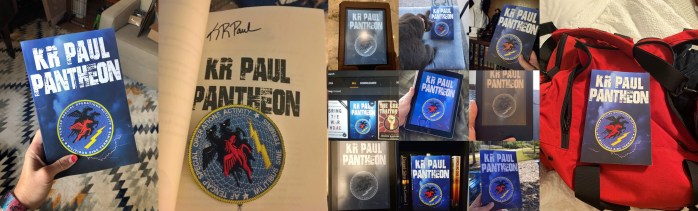
It’s been a wild month. I’m so thankful to my publisher, Force Poseidon for taking a chance on me. I’m grateful to my growing fanbase for the support. And I’m thankful to my friends and family for encouraging me and supporting me while I’ve chased this dream. I can’t wait to see how the rest plays out!
Enjoy what you just read? Please share on social media or email utilizing the buttons below, fans like you sharing what they love are what keeps this train rolling!
Want to read more works by Author KR Paul? You can find my first novel here and its sequel here.
Want more than that? Follow me on Twitter, Instagram, Facebook, and TikTok. Stay up to date on the latest KR Paul news by joining our mailing list.
Just looking for wild stories of cave diving, ultramarathons, blacksmithing, or powerlifting. Yeah, I’ve got those too!